

Protect your order from damage, loss, or theft during shipping.
A retired teacher from Edinburgh spent four years trying everything her doctors recommended. Then she found the research that explained why none of it was working — and what finally changed everything.

Margaret, 63, Edinburgh. Four years of broken sleep before she found what was actually causing it.
Margaret hadn't slept through the night in four years.
Not 3:15. Not 3:30. Always somewhere between 3 and 3:30am — her left hip would start first, then her knees, and she'd lie there calculating how many hours she had left before she needed to get up. She'd tried everything her GP and rheumatologist had recommended: glucosamine, omega-3, turmeric capsules, an anti-inflammatory diet, physiotherapy twice a week, a stationary bike. She'd cut out sugar, alcohol, and nightshade vegetables simultaneously.
Her joints got worse anyway.
"I wasn't managing my arthritis," she says now. "I was just living around it."
What Margaret didn't know — and what most people with joint pain are never told — is that the reason her supplements weren't working had nothing to do with the supplements themselves. It had to do with how she was taking them.
"Arthritic joints consistently contain as little as one third of the sulfur and magnesium found in healthy tissue. And most oral supplements never reach the joint at all."
— Rheumatology International, 2023 Review of 17 Clinical Trials
When researchers examine the cartilage and synovial fluid of arthritic joints, they consistently find the same thing: dramatic depletion of two minerals — sulfur and magnesium.
Sulfur, in the form of MSM (methylsulfonylmethane), is essential for maintaining the cartilage matrix — the structural framework that keeps joints cushioned and lubricated. Without adequate sulfur, cartilage loses its elasticity. The joint stiffens. Morning immobility sets in.
Magnesium regulates the body's inflammatory response at the cellular level. It calms the pain signals that cause night flares. It relaxes the muscles that tighten around inflamed joints during sleep. It supports the deep sleep cycles during which joint tissue repair actually occurs. When magnesium is depleted, the inflammatory response has no natural brake — and that's what wakes people up at 3am.
This isn't a fringe theory. It's documented in peer-reviewed rheumatology research. And yet most people with arthritis are never told about it — because the standard treatment protocol focuses on managing inflammation with NSAIDs, not on addressing the mineral deficiency that's driving it.
Ibuprofen, naproxen, and other NSAIDs suppress inflammation by blocking the COX enzyme pathway. The problem: this same pathway is involved in cartilage repair. Long-term use doesn't just mask the pain — research suggests it may accelerate cartilage breakdown.
Additionally, NSAIDs damage the gut lining — which is precisely the tissue responsible for absorbing the oral supplements most people are taking alongside them. The medication that's supposed to help you manage the pain is simultaneously reducing your ability to absorb the nutrients that could address its root cause.
16,500 people die each year in the US from NSAID-related complications — primarily gastrointestinal bleeding and kidney failure. This is not a rare side effect. It is a documented, well-established risk of long-term use.
Here is the problem that nobody explains at the pharmacy counter: when you swallow a glucosamine tablet, a magnesium capsule, or an MSM supplement, it has to survive your stomach acid, be absorbed through your intestinal wall, processed by your liver, and then diluted across five liters of blood before any of it has a chance of reaching your knee.
In a healthy adult under 40, some of it makes it. In adults over 60 — especially those who have been on NSAIDs for years, which damage the gut lining and impair mineral absorption — the bioavailability of oral magnesium is often less than 20%. Most of what you're swallowing is passing straight through you.
This is why so many people take glucosamine for a year and feel no difference. It's not that glucosamine doesn't work. It's that it never arrived.
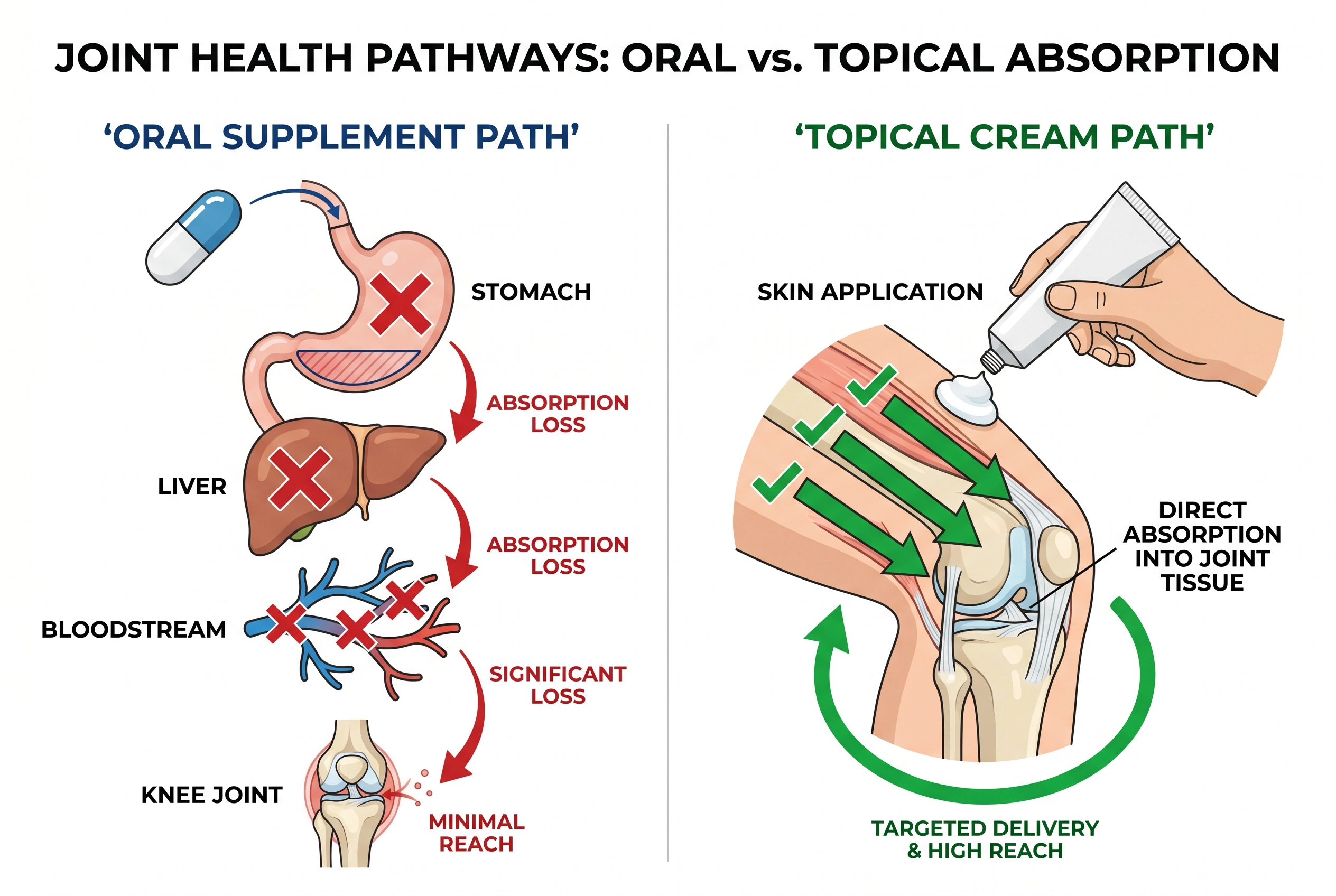
Why oral supplements rarely reach the joint — and how topical delivery changes the equation.
Topical delivery of magnesium chloride and MSM sulfur bypasses the entire digestive process. Applied directly to the skin over the affected joint, these compounds absorb transdermally — through the skin, into the local tissue, without touching your stomach, your liver, or your bloodstream.
The concentration that reaches the joint is dramatically higher than anything achievable orally. And because you're applying it directly over the specific area that's depleted, you're not relying on your body to route it correctly.
This isn't a new concept. Transdermal mineral delivery has been used in therapeutic settings for decades — from magnesium chloride baths used by athletes for muscle recovery to DMSO-based treatments studied by Dr. Stanley Jacob at Oregon Health Sciences University since the 1960s. What's new is the formulation: combining the two most depleted minerals in arthritic joints — magnesium and sulfur — in a single topical cream designed specifically for joint application.
When Margaret applied the cream for the first time, she didn't expect much. She'd been disappointed too many times. But within ten days, she noticed something she hadn't experienced in four years: she slept until 6:55am.
"I lay completely still for a full minute. The house was quiet. My hip was there — I could feel it — but it was a background murmur, not the sharp grinding that had been pulling me out of sleep for four years. I hadn't set an alarm. I'd just slept."
— Margaret, 63, Edinburgh
Zelora JointRevive Cream combines five active compounds, each addressing a specific aspect of joint mineral depletion and inflammation:
The most bioavailable form of transdermal magnesium. Regulates the NF-κB inflammatory pathway, calms pain signals that cause night flares, and supports the deep sleep cycles during which joint repair occurs. Arthritic joints are consistently depleted in magnesium — this delivers it directly.
Organic sulfur compound essential for maintaining the cartilage matrix. Arthritic cartilage contains as little as one third of the sulfur found in healthy tissue. MSM applied topically bypasses the poor oral absorption that makes supplementation ineffective for most people over 60.
Clinically studied for its anti-inflammatory and analgesic properties. Particularly effective for acute swelling and the localised pain that accompanies joint flare-ups. Works synergistically with magnesium to reduce the inflammatory response.
Boswellic acids inhibit 5-LOX, the enzyme responsible for the chronic inflammatory pathway that drives long-term cartilage breakdown. Where arnica addresses acute inflammation, frankincense addresses the chronic, low-grade inflammation that persists between flare-ups.
Relaxes the muscles that tighten around inflamed joints, particularly during the night. Also acts as a penetration enhancer, improving the transdermal absorption of the other active compounds. The scent has documented anxiolytic effects that support sleep quality.
Topical mineral delivery works differently from pharmaceutical pain relief. It doesn't suppress symptoms immediately — it addresses the underlying deficiency. Most people notice changes in this order:
The most common first change. The 3am wake-up becomes less frequent or stops entirely. Magnesium's effect on the inflammatory night flare is often the first thing people notice.
The stiffness that typically takes 45–60 minutes to work through starts clearing in 15–20 minutes. The cartilage matrix is beginning to replenish its sulfur content.
Sustained mineral delivery begins to address the chronic inflammatory pathway. Most people reduce their NSAID use significantly during this period — not because they're told to, but because they wake up and don't need it.
The cumulative effect of three months of mineral replenishment and reduced inflammation. People report walking further, climbing stairs more easily, and returning to activities they'd given up.

By month three, Margaret was walking two miles without stopping. "I'd stopped expecting that to be possible."
"I'd been on naproxen for three years. Within six weeks of using this cream I stopped taking it — not because anyone told me to, but because I woke up one morning and didn't need it. My GP was surprised. I wasn't."
"The morning stiffness was the thing that was destroying my quality of life. It used to take me an hour to function properly. Now I'm downstairs making tea within ten minutes of getting up. I can't explain how much that matters."
"My wife found this after I stopped going to my grandson's football matches. I was sceptical. Six weeks later I walked to the pitch, stood for ninety minutes, and walked back. She didn't say anything. She didn't need to."
"My joint pain started after menopause and nobody connected the two. This is the first thing that's made a real difference. The sleep improvement alone was worth it — I'd been waking at 3am for two years."
Zelora JointRevive is a high-concentration topical mineral cream formulated specifically for joint application. It combines the two minerals most consistently depleted in arthritic joints — magnesium chloride and MSM sulfur — with three botanical actives that address both acute and chronic inflammation.

Zelora JointRevive Cream — Magnesium Chloride, MSM Sulfur, Arnica Montana, Frankincense & Lavender.
If nothing shifts in 90 days, you get a full refund. No questions asked. No return required.
See Zelora JointRevive →Most people notice sleep improvement within the first week — this is typically the first change. Morning stiffness usually starts to reduce in week two. Significant pain reduction and mobility improvement generally occur between weeks four and eight with consistent twice-daily application.
Yes. Zelora JointRevive is a topical cream with no systemic absorption — it doesn't interact with oral medications. However, if you are considering reducing your NSAID use, please discuss this with your GP first. Many customers find they naturally reduce their medication as their symptoms improve.
Apply a small amount (approximately a 50p coin size) directly over the affected joint and massage gently until absorbed. Use twice daily — morning after showering and evening before bed. For best results, apply to clean, dry skin. It absorbs within a few minutes and leaves no greasy residue.
Zelora JointRevive is formulated for osteoarthritis, rheumatoid arthritis, and general joint pain associated with mineral depletion and inflammation. It is suitable for knees, hips, hands, wrists, shoulders, and lower back. If you have a specific medical condition, consult your GP before use.
We offer a 90-day money-back guarantee. If you don't notice any improvement after consistent use for 90 days, contact us for a full refund. No return required, no questions asked. We're confident enough in the product to make this commitment.
Zelora JointRevive delivers the two minerals most depleted in arthritic joints — directly to the joint, bypassing the digestive system that's been failing to get them there for years.
Try Zelora JointRevive — 90-Day Guarantee →This article is for informational purposes only and does not constitute medical advice. Always consult your healthcare provider before changing your medication or treatment plan. Individual results may vary.