

Protect your order from damage, loss, or theft during shipping.
A 2026 dermatology review identifies the exact layer where menopausal skin actually breaks down — and explains why even the most disciplined routines stop short of it.

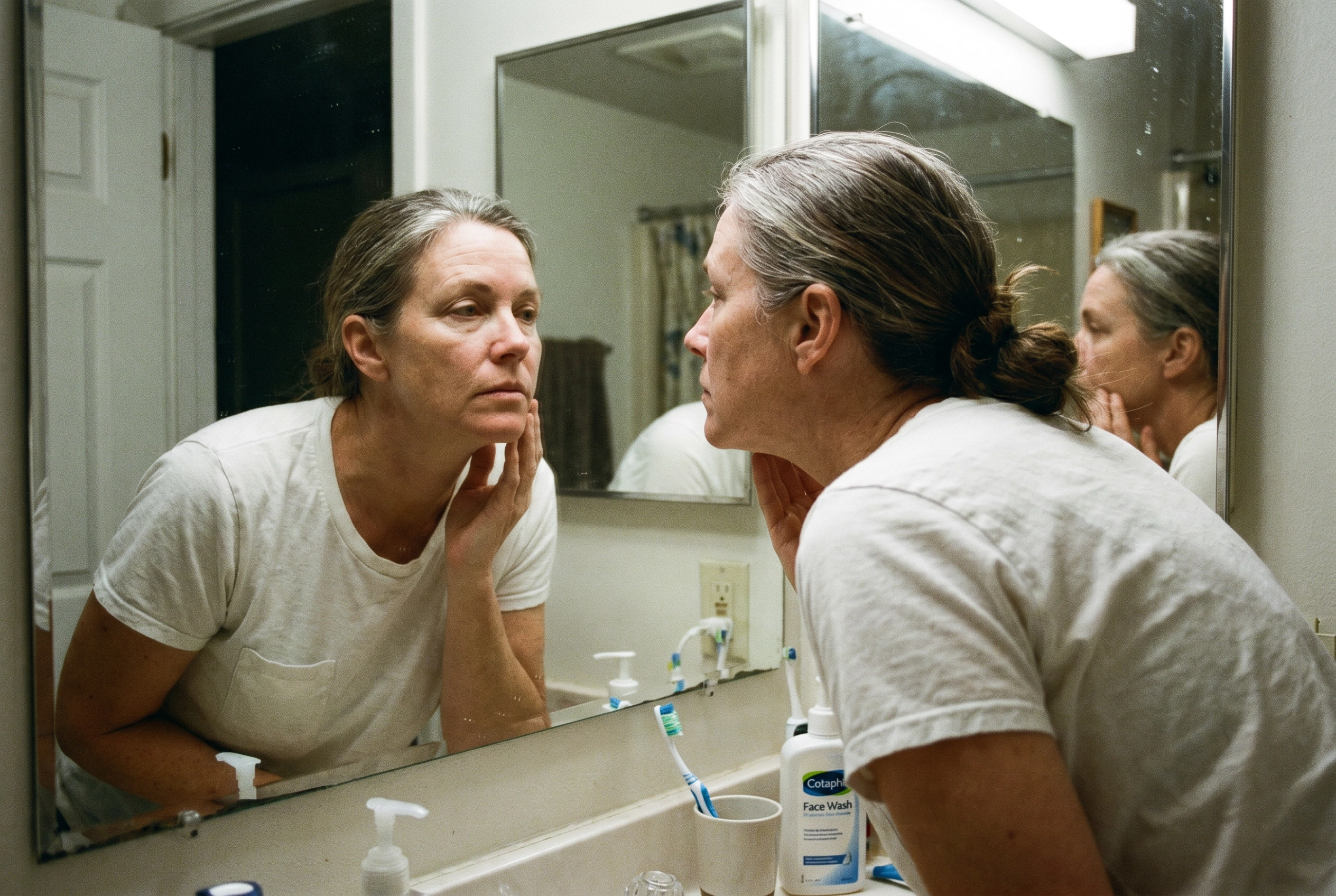
For millions of post-menopausal women, the problem is not the products — it is the layer those products were never designed to reach.
The women I spoke to for this article were not women who had given up.
They were women who had done everything right.
One had been on prescription tretinoin for five years. Another had a nine-step morning routine she had built and refined over three years of careful research. A third had spent just over £3,800 on serums, devices, supplements, and two Ultherapy consultations she had ultimately walked away from — not impulsively, but methodically, after reading every clinical paper she could find on each one.
None of them were vain. None of them were chasing something unrealistic. Every single one of them had the same specific, concrete, completely reasonable goal — they wanted to look like themselves again. The jawline they recognised. The neck that felt like theirs. The lower face that matched the person they still felt like on the inside.
And every single one of them had hit the same invisible wall.
The products kept working. Their skin texture was better than it had ever been. Their pores were tighter. Their fine lines had softened. Everything their routines were designed to do, their routines were doing.
But the thing that was actually wrong — the structural collapse along the jaw, the loosening at the neck, the falling of the lower face that menopause had triggered — was completely, persistently, unmovably untouched.
By the time they found me they were not asking what to try next.
They were asking why their best work had stopped being enough.
I think I finally have an answer. And it does not require throwing out a single product.
I want to say this carefully because it is the most important sentence in this article.
The retinol was working. The peptide serums were working. The collagen supplements were doing what collagen supplements do. The HRT, for the women on it, was improving sleep and joint comfort and cognitive clarity exactly the way the studies said it would.
None of these tools had failed.
What had happened was something different. Something that almost no conversation about menopausal skincare ever reaches directly.
Every one of these women had been working the right tools on the wrong layer.
That is the entire story of this article in one sentence. Their routines were not failing because of effort or expense or expertise. They were failing because of geography. There is a specific layer of skin — a deep structural layer that sits beneath everything most topical products are formulated to reach — where the actual breakdown was happening. And almost nothing in any of their routines was designed to get there.
Understanding that distinction changed everything for the women I spoke to.
It will probably change things for you too.
A review published earlier this year in the International Journal of Women's Dermatology consolidated three decades of research on a single question — what actually happens to the structural layer of skin during and after menopause, not at the surface but at the level of the cells responsible for building and maintaining the deep dermal scaffold.
The findings are not subtle.
The review identified a mechanism researchers are now calling Collagen Signal Collapse. Here is what that means in plain language.
Deep in the dermis — below the epidermis, below the layer that most topical products reach — sit cells called fibroblasts. Fibroblasts are the architects of your skin's structural scaffolding. They are responsible for producing and maintaining the collagen and elastin that holds your jawline defined, your neck taut, your lower face in the position it held for the first four or five decades of your life.
Fibroblasts do not work independently. They work in response to signals. And one of the most critical signals governing their activity is estrogen.
During the menopausal transition, estrogen does not decline gradually and manageably in a smooth curve. It fluctuates dramatically and then drops. When it drops, the signalling system that activates fibroblast collagen and elastin production does not slow — it collapses. The fibroblasts go quiet. Scaffold production at the deepest dermal layer stops.
And the skin above that structural layer does not slowly accumulate wrinkles from the surface downward.
It falls.
The jawline softens and then disappears. The neck loosens. The lower face loses its architecture in a way that feels — and is — sudden, structural, and happening in a layer that almost nothing being marketed to menopausal women was ever designed to reach.
This is why it felt like it happened overnight. Because structurally, it did.
The review identified something specific about the timeline that explains why so many women describe the same experience — looking in the mirror one day and not recognising the lower half of their face.
In the first five years of the menopausal transition, women lose up to 30% of their dermal collagen. Not gradually. Not spread evenly across decades. Thirty percent in five years — concentrated precisely in the period when fibroblast signalling collapses fastest and the scaffold loses its structural support most rapidly.
This is not normal ageing accelerated. This is a specific biological event happening in a specific layer on a specific timeline. And almost no one explains it to women before it happens.
"The patients who struggled most were the ones doing everything right. Disciplined routines, good products, real commitment. Watching them cycle through solutions year after year, knowing that nothing they were using was built to reach the layer where the problem actually lived — that was the hardest part of practice."
— Dr. Maren Holst, Board-Certified Dermatologist, 17 years in practice
Dr. Maren Holst reviewed the formulation and noted three of its seven actives would be on her own recommendation list for post-menopausal patients.
Once you understand where Collagen Signal Collapse is happening, every familiar product reveals its geographic limit.
The cause was never just the estrogen leaving. It was the fibroblasts going silent in a layer below everything she was treating — and the structural collapse continuing there, unaddressed, while her routine worked faithfully on the layers above it.
The serum built specifically to reactivate fibroblasts at the dermal scaffold — the layer your current routine stops short of.
Start the Fourth Piece — 60 Days, No Risk →60-Day Guarantee · Free Shipping · Keep the Bottle Either Way
If you map a sophisticated menopausal skincare routine onto the layers of skin it actually addresses, the picture clarifies quickly.
Surface turnover is covered by retinoids. Hydration and barrier function are covered by ceramides and hyaluronic acid. Fine lines and brightness are covered by surface vitamin C and niacinamide. Three layers, each with real tools doing real work.
What almost no routine includes is the fourth piece — dermal-layer fibroblast reactivation. The intervention that speaks directly to the cells responsible for rebuilding the structural scaffold. The piece that addresses the layer the 2026 review names as the actual site of menopausal skin collapse.
That category of product is genuinely harder to find than the marketing landscape suggests. Most of what presents itself as structural or deep-acting is still epidermal work dressed in impressive clinical language. The mechanism sounds right. The layer it reaches does not.
The first formulation I found that was built specifically around fibroblast reactivation at the dermal scaffold level — not surface treatment positioned as structural, but a formulation architecturally designed for the fourth layer — was Zelora Snap-Back Serum™.

Collagen Signal Collapse happens in the dermal scaffold — below the layer that retinol, peptides, and standard vitamin C are formulated to reach.
Three things stood out from a research standpoint.
First — it is the only product I came across that names Collagen Signal Collapse as the explicit target. Not anti-aging. Not firming. Not lifting. The mechanism is named and the formulation is built around it from the ground up. That distinction matters more than it might sound.
Second — it was designed as the fourth piece for an existing routine. Not a replacement for anything a disciplined woman is already doing. You do not throw out your retinol. You do not change your peptide serum. You add the piece that reaches the layer none of them were designed to reach.
Third — the active ingredients are not proprietary blends hiding behind brand language. They are named, researched, and individually supported by peer-reviewed clinical evidence.
Acetyl Hexapeptide-8 is a signal peptide clinically studied for its ability to penetrate to the dermal scaffold and reactivate fibroblast collagen and elastin production at the structural level. This is not a surface peptide. It is a deep communication molecule that speaks directly to the cells responsible for rebuilding what menopause collapsed.
Ethyl Ascorbic Acid is a stable, penetrating form of Vitamin C shown in 2021 research to significantly increase collagen synthesis in human dermal cells — not at the surface, at the fibroblast level. It cross-links newly produced collagen fibres as they form, giving them the tensile strength that makes scaffold reconstruction visible.
Bakuchiol accelerates collagen gene expression inside the fibroblasts themselves, compounding the reactivation effect from the architectural layer upward. Multiple peer-reviewed trials have confirmed equivalent results to retinol without the irritation — making it the first ingredient in this formulation that can work alongside an existing retinol routine without conflict.
Niacinamide at clinical concentration supports ceramide synthesis and reduces the rate of collagen degradation simultaneously — addressing both the production and the preservation sides of scaffold rebuilding.
I asked Dr. Holst to review the full formulation. Her response came back the same day.
"Sensible. Not a gimmick. The formulation is built around the mechanism — not around marketing language. Three of the actives would be on any list I would give a menopausal patient who asked me directly what to add to an existing routine. That is rarer than it should be."
— Dr. Maren Holst, Board-Certified DermatologistOne woman I spoke to — 58, on tretinoin since 2016 and HRT since 51 — added one step to her existing routine and changed nothing else.
The texture at her jawline changed noticeably at week three. Around week seven she caught her reflection in a shop window on a Saturday afternoon and stopped walking.
At her next dermatology appointment the doctor asked twice in the same visit what she had changed. She showed her the bottle. The dermatologist read the ingredient list and asked her to send the link.
Another woman, 61, had been told at her previous appointment that her dermatologist had run out of clinically appropriate suggestions short of non-surgical lifting procedures. She added one serum instead. At her next appointment the same dermatologist — who had seen her every six months for four years — asked what she had done differently.
A third — 54, perimenopausal, who had described her jawline situation to me as "the thing I had accepted I couldn't fix without surgery" — told me she noticed the change first in photographs. Not dramatically. Not overnight. But in a way that made her stop deleting them before anyone else could see.
That moment — stopping deleting the photos — came up in almost every conversation I had for this article.
It was a smaller thing than surgery. It was a larger thing than skincare.
It was looking like themselves again.

Designed as the fourth piece — layers over an existing routine without replacing anything.

No results within 60 days — one email, full refund. No return required. Keep the bottle either way.
"I have been on tretinoin for six years and HRT for three. I genuinely believed I had covered everything. I added this at week one and by week six my husband asked if I had done something to my face. I had not done anything different except this one serum."
"My dermatologist told me at my last appointment she had run out of things to suggest short of filler. I found this article, ordered the serum, and at my next appointment she asked me twice what I had changed. I showed her the bottle. She read the whole label."
"The jawline definition came back first. Then the neck. I am not going to say it reversed ten years because that is not what happened. What happened is I looked like myself again. That is all I wanted."
"I was skeptical. I have been skeptical of everything for four years and I was right to be every single time. This is the first thing where I was wrong. Week four I noticed something. Week eight I believed it."
"I spent £3,800 on things that did not work before I found this article. I am not angry about it anymore. I just wish someone had sent me this two years earlier."
"Three months in. My sister asked me at Christmas if I had done something. I told her one new serum. She asked for the name before we sat down for dinner."
No results within 60 days — one email, full refund. No return required.
Editorial Disclosure: This article contains affiliate links. Women's Skin Health Review may receive a commission if you purchase through links on this page. This does not influence our editorial coverage. All statements reflect the writer's independent research and reporting.
Medical Disclaimer: This article is for informational purposes only and does not constitute medical advice. Consult a qualified healthcare professional before beginning any new skincare regimen, particularly if you are on prescription medications or have underlying skin conditions. Individual results vary.